
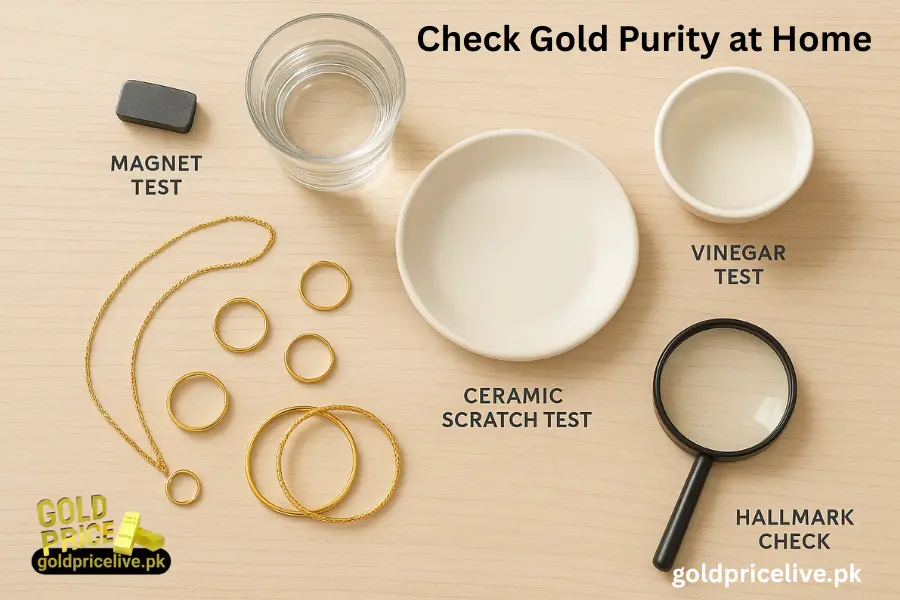
How to Check Gold Purity at Home Without a Machine (Complete Guide)
In this post, we will discuss how you can easily test or Check Gold Purity at Home; whether it is 22k, 24k, 21k, etc.
We will provide several methods to check gold purity, but do not rely 100% on just one test. Always perform 2 or 3 tests for better confirmation.
Remember, these methods are quick ways to identify whether the gold is pure, mixed with other metals, or only metal coated with a layer of gold.
Why Checking Gold Purity at Home Is Important
Everyone knows gold is a valuable and very costly metal. Some people buy gold for jewellery, while others buy it for future investment. If you buy gold and do not check how much other metal is mixed in it, you may save it for years but later, when you sell it, you might not recover your money.
If you are buying gold, you must learn the methods of checking gold purity. This can save you from loss and fraud.
With these simple steps, and without using heavy or expensive machines, you can easily check your gold before buying. The person selling the gold will also know that you are not inexperienced. They will treat you with respect and consider you a smart, professional buyer.
Now let’s start our step-by-step guide to checking the purity of gold at home without using machines.
Best Ways to Check Gold Purity at Home Without a Machine
- Magnet Test (Quick & Simple Test)
- Water Density Test (Float or Sink Test)
- Ceramic Scratch Test (Unglazed Plate Method)
- Skin Test (Body Reaction Test)
- Vinegar Test (Safe Chemical Test)
- Hallmark Checking (Most Reliable Home Method)
- Makeup/ Foundation Test

1. Magnet Test (Quick & Simple Test)
A simple and quick test is the magnet test. Take a small magnet and bring it close to your gold bar or gold jewellery. If the gold is slightly attracted to the magnet but does not stick, it means some other metal is mixed with the gold.
If the gold sticks strongly to the magnet, then understand that it is not real gold—it is another metal with a thin gold coating.
Note: These days, some fake metals also do not stick to magnets, which is why you should never rely on just one test. Always perform two or three tests for better results
2. Water Density Test (Float or Sink Test)
For this test, take a glass of water and gently drop your gold item into it. If the gold instantly sinks to the bottom, it means the gold is likely pure. But if it sinks slowly or floats on the water, then it is not real gold, because real gold is dense and heavy. Pure gold does not float; it sinks immediately.
3. Ceramic Scratch Test (Unglazed Plate Method)
This is a simple test. Take a white ceramic plate with a rough surface and gently rub your gold item on it. Look closely at the mark it leaves. If the mark is yellow or gold in color, it means the gold is likely pure. If the mark is black or another color, it means the item is not real gold—only the outer layer is gold, and the inside is another metal.
Do not use this method on new gold jewellery, because it can leave a tiny scratch on the gold.
4. Skin Test (Body Reaction Test)
This is another simple test to identify gold purity or real gold. In this test, wear a gold ring or bangle for a few hours, then remove it and closely examine your skin. If you see green or black marks where the jewellery was, it means the gold is not pure or has low purity, as it is mixed with other metals. Real gold does not leave any marks on the skin.
5. Vinegar Test (Safe Chemical Test)
Take a bowl and put your gold jewellery or other gold items in it. Add a few drops of white vinegar. If the gold is real, there will be no reaction. If it changes color or produces bubbles, then it is fake or a low-purity gold item
6. Hallmark Checking (Most Reliable Home Method)
This is one of the most reliable and easy ways to check gold. Every genuine gold jewellery piece has a stamp called a hallmark. It usually looks like 900, 916, 999, or 22k, 21k, 24k, or 18k.
To see this stamp, use a magnifying glass and look closely at the jewellery.
- If your gold is 24k, the mark is 999.
- If it is 22k, the mark is 916.
- If it is 18k, the mark is 750.
If you do not see this stamp, it could mean the item is handmade, antique, or fake gold.
7. Makeup/ Foundation Test
This is a surprisingly accurate test. Take liquid makeup foundation and apply it on the back of your hand, then let it dry. Once dry, gently rub your gold item on that spot. If the gold leaves a black line or mark, it means the gold is real. If no mark appears, the gold is fake.
When You Should NOT Test Gold at Home
Please avoid home testing if you have any of these types of jewellery:
- Gemstone jewellery
- Items with pearls
- Antique or delicate pieces
- Jewellery with loose stones
- Cracked chains
These types require professional checking to avoid damage.
Tips to Avoid Buying Fake Gold
- Always buy from a trusted jeweller
- Look for a proper 22K/24K hallmark
- Ask for a gold purity testing certificate
- Always check today’s gold rate before buying
- Compare the weight and price from at least two shops”
For the latest updates, visit our Home Page, check the Gold Rates in Pakistan, explore the International Gold Rate, and use our Gold Price Calculator for accurate conversions.
FAQs – How to Check Gold Purity at Home
Why is it important to check gold purity at home?
Checking gold purity ensures you are buying real and valuable gold, not fake or low-quality gold mixed with other metals. This helps protect your investment and prevents financial loss or fraud.
What are simple ways to test gold purity without machines?
Common home methods include the magnet test, water density test, ceramic scratch test, skin reaction test, vinegar test, hallmark checking, and even the makeup/foundation test. Performing 2–3 tests together gives better confirmation.
How do I identify real gold using hallmarks?
Genuine gold jewellery is usually stamped with numbers or karats: 999 for 24K, 916 for 22K, 750 for 18K, etc. Use a magnifying glass to check for these stamps on your jewellery.
Which types of jewellery should NOT be tested at home?
Avoid testing gemstone jewellery, items with pearls, antique or delicate pieces, jewellery with loose stones, and cracked chains. These should be checked by a professional to prevent damage.
How can I avoid buying fake gold?
Always buy from trusted jewellers, look for proper hallmarks (22K/24K), request a gold purity certificate, check the current gold rate, and compare prices and weights from at least two shops before purchasing.


